
Any genealogy book worth its salt will advise you to research an ancestors siblings and other collateral relatives as well as the ancestor themselves. I've read this many, many times and I wish I had a dime for every time that I've read it.
I'll confess that this is a lot easier to say than to put to practice. Only recently have I begun to fill in the holes in my family group sheet in regards to some one of my ancestors' siblings and half-siblings.
Awhile back I heard how FamilySearch is digitizing many their records. I checked out what was available, but wasn't too impressed because much of what was available weren't items that I didn't already have.
I'm really not too fond of doing genealogical research online and I don't recommend it as a rule. My belief is that you should always, always try to find the documents you need from an archive, Family History Center, or courthouse. Lately when I've been exploring what's available I've found that there are a lot of digital records out there.
The collateral relatives for Albert Womble are his siblings, Maude B. Cudworth, Thomas Jefferson, Ernest Allen, and Charles. Albert also has half-siblings that are from his father, John Washington Womble's first marriage to Mary Jane Stephens. I believe that John's first wife died around the Civil War and he married Rhoda Caroline Richardson after the war. The children that John W. had with Mary Jane are: Joab, Ellen, Adolphes Winfield, Martha L., Tranquilla Blanche, Franklin, Ruffin, and Jesse.

The shocking thing I found is that Ancestry has a selection of digital images of documents on their site. Recently I searched for Tranquilla Blanche Womble or Wamble as it's sometimes spelled, she's one of Albert Womble's half-siblings. My search came up a digitized image of her death certificate. I was floored because I really thought that I wouldn't find anything!
I tried to find death information for her brother, Adolphes Winfield Womble, they seemed to live together for their entire lives, but was unsuccessful. I did a search on Ancestry of the census records for that household which consisted of Adolphes, Martha L., and Tranquilla Blanche in 1880 living in Hardeman County, Tennessee. A search of the 1900 Federal Census showed Adolphes and Blanche living in McNairy County, Tennessee without Martha. My belief was that she may have died after the 1880 census and before 1900, but after searching for a death record, I came up empty. My research into the recording of death information in Tennessee is that if a person died in a non-metropolitan area before 1914 then there probably isn't a record of it. Even though recording was put into practice in 1914, it wasn't pervasive and I believe that if the death occurred before 1918 or 1920 there's the possibility that it wasn't recorded even though official registration had started in 1914.
My thoughts turned to how could I at least get an idea of when Adolphes and Martha died. The solution: probate records. I wasn't sure if Adolphes had left anything to his sister, Blanche but a search wouldn't hurt.
I did a search of the USGenWeb's archive for the state of Tennessee and came up with a transcription of a probate index for McNairy County, Tennessee. This was searched for Blanche and Adolphes and I found a listing for them with the page number.


I took this information with me to FamilySearch's website and searched through their digitized probate records. In case you decide to try this at home, please keep in mind that the page numbers on their digital image viewer don't tally with the printed pages on the pages of the probate books. Simple common sense helps to find the page. I was able to print the images, which was great. There wasn't any date on Blanche's will, but Adolphes' said he was deceased and had the date of 7 July 1919 on it. While it would be great to find an exact death date, something is better than nothing.
A search was done for deaths and probate records in Hardeman County, Tennessee for Martha L. Womble, but nothing was found. My belief was that she probably died there because it's the last place of residence that I know of.
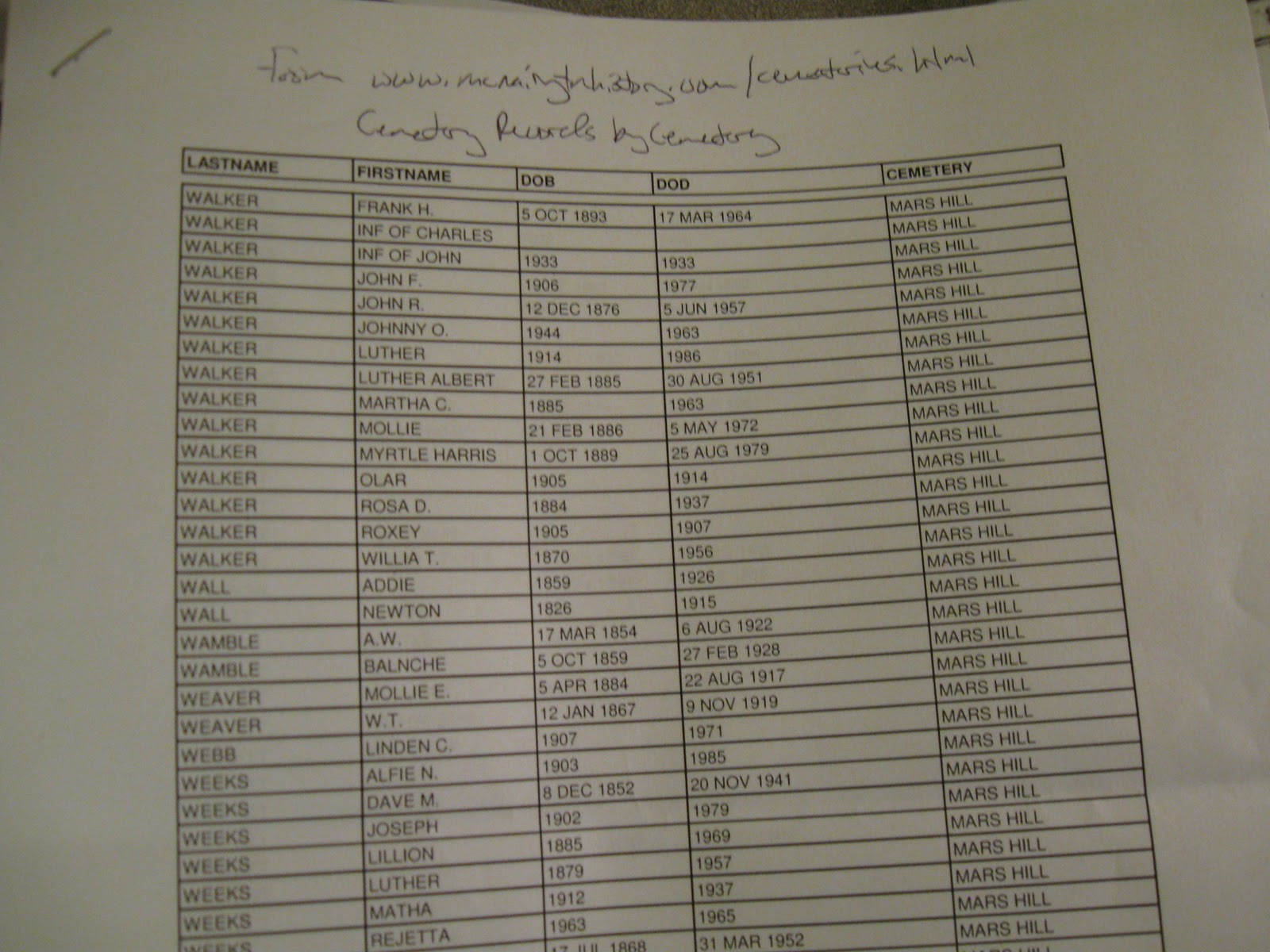
I did a search of cemetery records for McNairy County at www.mcnairytnhistory.com/cemeteries.html and found a listing for both Blanche and Adolphes at the Mars Hill Cemetery that's mentioned on Blanche's death certificate. The cemetery is located in Adamsville, Tennessee and that's another place to search for records too. There's a death date for Adolphes on the page that says he died 6 August 1922. I don't know if that's true. It still seems weird to me that if he died in 1922 then why haven't I been able to locate a death certificate for the man.

While I was searching away on Ancestry, I did a search for Ellen Womble, who is another one of Albert Womble's half-siblings. I already knew that there is a public tree with her in it on the site and so I looked at that information to try to see if I could actually verify some of the data. I was able to locate a digitized image of her marriage record to Isham Burgess Bowling on 4 August 1869 in Hardeman County, Tennessee. So that's why she wasn't listed as living with her father in 1870, because she was married by then and living with her husband. The rest of the information on her is unconfirmed, but it states that she moved to Texas with her husband, had many children with him and he died around 1882 and I don't think that she ever remarried. Ellen or Nellie as I see her referred to, died in Texas in 1924.
Today, I did a Google search for Ellen's older brother Joab, and was surprised by what I found. Someone, who I should try to make contact with has a collection of photos on a website that seems devoted to picture sharing. This person appeared to be connected to the Bowling family and Ellen was their grandmother or great-grandmother. They had posted digital images of letters from both Joab and Blanche that were written to their sister, Ellen. Another picture showed a digital image of information that someone had written about Ellen, her husband Isham Bowling, and her siblings. This information mentioned a letter from Martha L. who was referred to as Mattie. Mattie apparently wrote her sister in 1918 from Vernon, Missouri.
Unfortunately, I saw no way for me to copy or print the information at least for my own use without joining the site. But at least I knew I was wrong to assume that Martha had died because she had written to her sister in 1918!

Since I already know that there were digital images of Tennessee marriage records on Ancestry, I went there and searched for a marriage record for Martha Womble to someone. I found a marriage record for a Mattie Womble to C. A. Long in McNairy County, Tennessee on 24 August 1898. I'm not sure if this is the Mattie Womble I'm looking for, but it seems plausible because her siblings were living in McNairy County in 1900 and while I don't know when they moved there it just seems that it is my Mattie.
I did find a census record for a couple named Charlie A. and Mattie Long living in Vernon, Missouri in 1920, so it seems as if this is the missing Womble relative. I still haven't come across a death record for either Charles or Mattie, but I'll try to remain vigilant in my search.
I still have not been able to find any additional information on Joab and he still remains my mystery man. What's with him going off and fighting for the Confederacy, disappearing and then reappearing in the 1910 Federal Census in Taney County, Missouri anyway?!
Nor have I verified that Mary Jane Stephens and her three young children, Franklin, Ruffin, and Jesse died. The person with the photo online did mention them and said that they didn't have any letters from them that were sent to their sister. This makes me think that those kids really did die, I don't know about their mother, and I may never have an answer.


