Sunlight

Sunlight

Friday, August 30, 2013

Womble, Wamble, and Wormble?!


So, if you’re a regular reader of my blog you may know that I’ve been trying to learn more about the Womble family’s Civil War experience.  The family story is that John Washington Womble spent the Civil War working in Nashville, Tennessee as a tailor and left his children to fend for themselves in Hardin County, Tennessee.  I’ve already reported about finding an interment record for who may possibly be his first wife, Mary Jane in the Nashville City Cemetery.  I also located what I believe to be interments for two of his three children that were listed in the 1860 Hardin County, TN census, but no records seem to exist for them afterwards, until I found the cemetery information. 
1860 U.S. Census, Hardin County, Tennessee, John W. Womble household
While working at a genealogy conference last week in Ft. Wayne, Indiana, I took the opportunity to visit the Allen County Public Library and do some work on this family story.  Whenever I’m researching the Womble family I keep in mind to be on the lookout for varying spellings of the family’s name.  One of the spelling variations I’ve come across is Wamble. 

At the Allen County Public Library I discovered another variation—Wormble—yes that’s right—Wormble.  I was looking through a book that was an index of interments in the Nashville City Cemetery.  I didn’t expect to find anything new, but I came across a Wormble, Frank.  The other two Womble children I found listed in a Nashville City Cemetery interment database were just listed as infant Wamble.  No ages were given for them except for the notation son and child of J. W. Wamble.
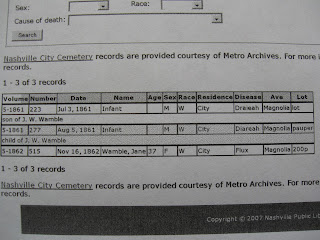
This notation gave me the impression that those listings were for the youngest two of the three “missing” Womble kids from the 1860 census.  So my thought was where is the oldest of the three youngest kids, Franklin?  I wondered if perhaps he died before John W. and Mary Jane relocated to Nashville.  However, based on my finding it appears that Franklin died that same summer of 1861 along with his two youngest brothers.
I can’t believe that the family would’ve taken only the youngest children with them to Nashville when the war started.  It was a different time back then and kids did grow up and take on adult responsibilities even when they were teenagers or pre-teens.  However, leaving even teenagers to essentially fend for themselves in an uncertain era and a potentially dangerous environment coupled with the fact that I’ve found evidence suggesting that John W.’s wife and some of their children were in the city with him makes me think that the story isn’t true. 

More research will have to be done on this to see if I can find anything else that may disprove my theory and prove the validity of the story.

Thursday, July 18, 2013

Using Collateral Research to Verify Womble Civil War Story

Previously, I posted about wanting to find out if a family story was true. This was posted on this blog March 23, 2013. I’ve spent much of the summer trying to confirm the story’s validity by researching the H. F. Myers who co-signed John Washington Womble’s marriage bond to his 2nd wife, Rhoda Caroline Richardson.

My thought had been that by finding out more about this Myers guy, I would either learn some connection between him and John’s 2nd wife, or uncover a connection between Myers and my John W.

Census records revealed that H. F. Myers would’ve been a contemporary of John’s, since he was 36 in 1860 and John was about 42. Nashville city directories showed that Myers was a merchant and more specifically owned a tailor shop on Cedar St. in the city. The 1866 Nashville city directory lists John W. Womble’s profession as a tailor. His occupation is further backed up by other census records, city directory listings, and family lore.

However, I’m sure that there were many other tailor shops in Nashville in the early to mid-1860’s that could’ve employed my great-great grandfather. Yet, if John didn’t work for him then why would Myers co-sign a marriage bond for a man that he didn’t have any connection to?

I viewed land records that H. F. Myers purchased around the point in time when John would’ve been living in the area thinking that he might be listed as a witness. However, John wasn’t a witness to these records or at least that detail wasn’t recorded.

Shortly after the Civil War ended and after John and Rhoda married, H. F. Myers died. He left a will, but the will doesn’t mention John. Nor, is John mentioned as having witnessed Myers writing the will when it was presented in court. I still haven’t been able to view the court case of Robert Carter for stealing a coat from Myers’ store in May 1865. It may be that John didn’t witness the theft, because it occurred after he and Rhoda married, he may have been on his honeymoon or have left the city.

As a way to further my research I got a book via inter library loan on the occupation on Nashville during the Civil War. The book makes mention a few times that when the Confederate military was vacating the city and the Union troops were moving in that so many businesses were closed. The city streets were so void of people as if it were a Sunday.

Reading this made me wonder how John could’ve continued to live in the city without being able to go to work. However, the fact that he married there in 1865 seems to give evidence that he somehow was able to eke out an existence. Myers could’ve lost many employees as people enlisted in the military or vacated the city at the start of the war or later when the Union army took over. John could’ve decided to stay on in the city, because by the time that the Confederates were losing their hold on Nashville, his wife might have been too ill to travel back to their home in Hardin County. By sticking it out in the city, John could’ve shown his loyalty to Myers. This might have led Myers to co-sign John’s marriage bond to show his appreciation or gratitude.

There’s also the idea that when John initially worked as a tailor in Nashville that he didn’t work for Myers, but did later because his previous boss decided to close up shop and leave the city before the Union forces arrived.